News & Activities
Latest News
👥 Transforming Data into Insight with the Tableau User Group hosted by Quantum Analytics (October 2026)
My HSG students Yann Rochaix and Jonas Weber presented on data visualization with R. They asked whether higher healthcare spending leads to better health outcomes and built the answer in #R layer by layer (data, aesthetics, geometries, facets, statistics, coordinates, theme). Their goal was to tell a compelling story that engages specialists and decision makers.
We then rebuilt the analysis together in Tableau. From our conversation, it was clear that both R and Tableau can be used as complements, since they sit on different parts of the data analytics pipeline and mostly serve different groups of data consumers.
👉 Link to the slides: Transforming Data into Insight
👥 R in Healthcare with the Zurich R User Group (September 2026)
Together with the Zurich R User Group team, I organized our “End of SummeR” meetup at SWICA in Winterthur, on R in healthcare.
👉 More about the talks: R in Healthcare @ SWICA, Winterthur
🎓 CAS Course “Coordinated Care in Healthcare” (September 2026)
Together with my colleague Christian Frei, I taught the introductory module of the CAS “Koordinierte Versorgung im Gesundheitswesen” at ZHAW: an economist’s take on why the market alone under-delivers coordinated care, and what we’re doing about it at SWICA.
Blog post (German) | Course details
🎓 Brand new course “Introduction to Programming for Economists” is over! (June 2026)
Our brand new course “Introduction to Programming for Economists” at the University of St. Gallen just completed its first run!

Some months ago, my colleague Franziska Bender and I were asked to build, from scratch, a full programming course for our ~230 Undergrad Econ students at University of St.Gallen. The goal: give them the basic toolkit they’ll need for research and work as economists. The course focuses on collaboration, code reusability, and reproducibility. In the era of AI and vibe coding, we decided to focus less on coding in the narrow sense, and that choice feels right in hindsight.
It was a lot of work: new content every week, new exercises, figuring out what worked as we went. But looking back, our students went from using a terminal for the first time in January to now collaborating with git on Python classes that connect to SQL databases.
👉 Check out the course website for more details: Introduction to Programming for Economists
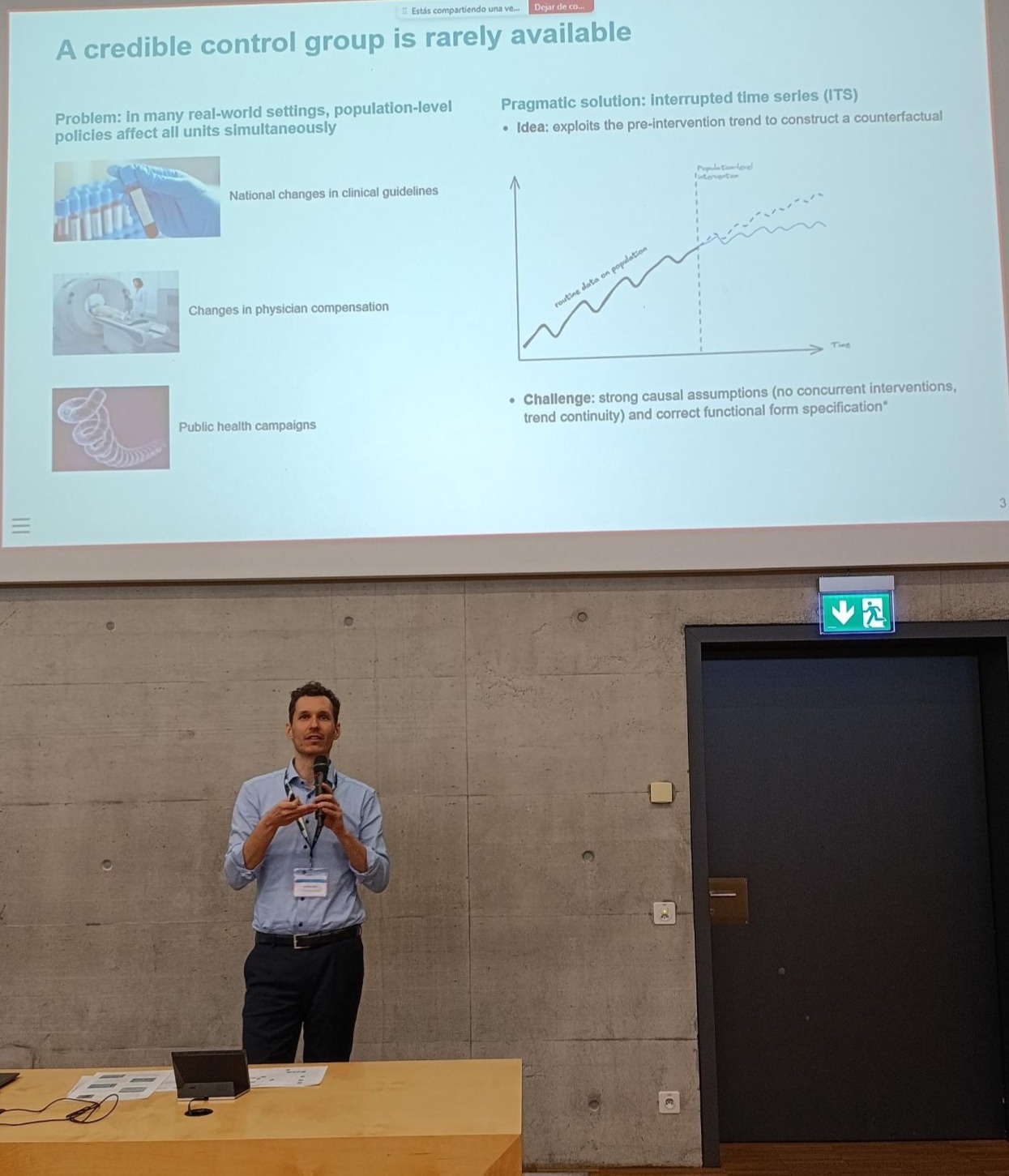
🎤 Keynote at the Causal Inference Symposium (18 March 2026)
2026 Symposium of Causal Inference in the Health Sciences organized by #PopHealthLab in Fribourg. Topic: Measuring the Effects of Population-level Interventions Using Healthcare Claims Data — interrupted time series, Swiss claims data, and the itscausal package.
📰 New Publication (October 2025)
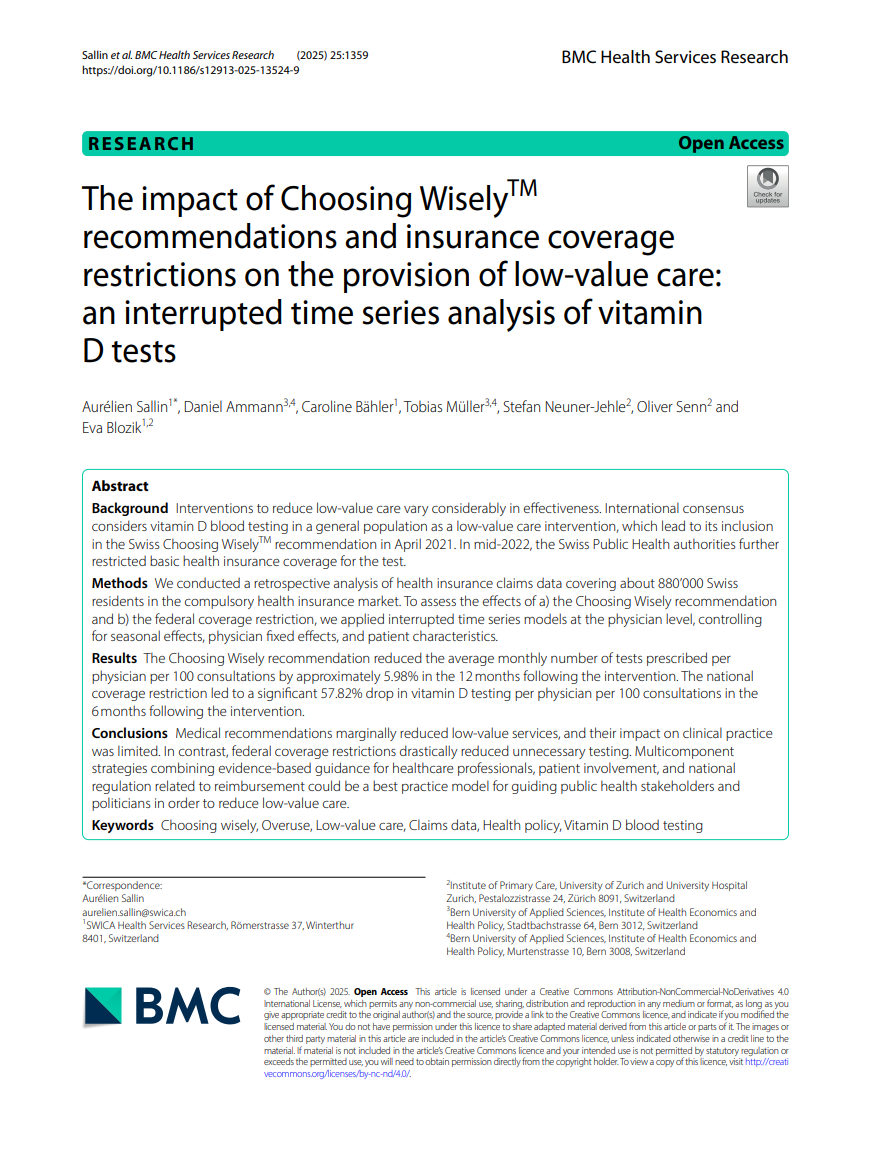
“The impact of Choosing WiselyTM recommendations and insurance coverage restrictions on the provision of low-value care: an interrupted time series analysis of vitamin D tests” published in BMC Health Services Research
Read Study | Check my summary blog post (with cool graphs!)
📊 Key findings:
Clinical recommendations alone are insufficient to reduce low-value care in the case of Vit D tests. Insurance coverage restrictions proved more effective than guidelines, reducing unnecessary vitamin D testing by 62% and saving 15.65 million CHF annually. However, coverage restrictions increase administrative burden and risk underuse.
📺 Media Coverage
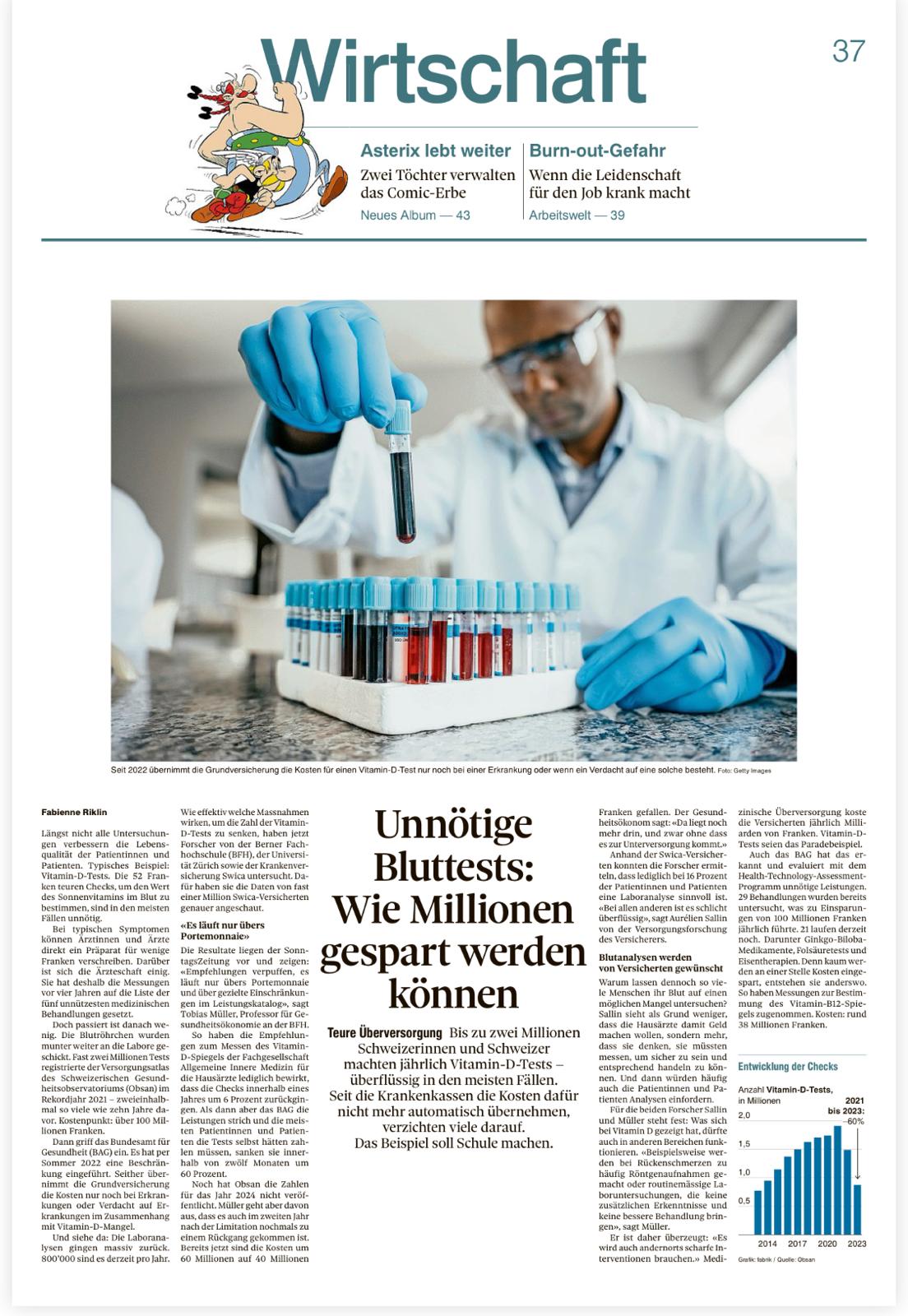
Our research on reducing unnecessary vitamin D testing has been featured in the “Sonntagszeitung” (pdf version) and the “Tages Anzeiger” (pdf version)
Complete Academic Record
For a comprehensive list of publications and citations, visit my Google Scholar profile.